mononews.gr
Peggy Kliafa: I seek to redefine reality
How healing on a macroscopic level is achieved through art
By Katerina Dafermou
In her recent solo exhibition at Zoumboulakis Galleries, Peggy Kliafa approaches two interconnected axes – on both a conceptual and material level: Healing and the Grid. Through the striking compositions presented in the exhibition “Healing the Grid”, the multidisciplinary artist does not seek “an escape from reality, but rather a renegotiation and re-signification of reality,” as she herself notes.
The grid, as Peggy Kliafa understands it, “is both physical and symbolic, metaphorical. It is the urban grid, the city itself, social media and the internet, digital surveillance, as well as the human body – a system that facilitates us on the one hand but also limits us on the other.
In a sense, the grid includes everything that constitutes the modern Western demanding lifestyle, especially in big cities.”
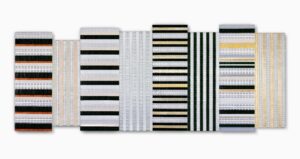
The grid as a structural and symbolic unit
Her work has always been connected to the grid, morphologically and conceptually. Through architectural elements, health practice issues and existential reflection.
However, in this case, “the idea of bringing the two together emerged because I came to see medication—and its overconsumption—as a consequence of the pressures of urban life, particularly in the metropolis, which has become virtually synonymous with the grid.” Not only of the city, but also of the Western way of life and hyperconnectivity in general, which represents another group of grids and networks in our everyday life.
What mainly concerns me is how we react to the visible or subcutaneous pressure exerted by these various grids. How do we deal with the physical and mental health issues that arise from this speed and pressure, why do we resort too often to medication, avoiding the search for the cause of the problems and the painful changes in ourselves and our habits?
The grid as a structural and symbolic unit, on the one hand represents the order, control, rationality of modern urban life – it is almost a form of compulsion.
On the other hand, in medicine we encounter various kinds of grids: networks of neurons, circulatory or lymphatic systems – structures that suggest life, flow, change. The idea of healing the grid was born out of this duality as well.”
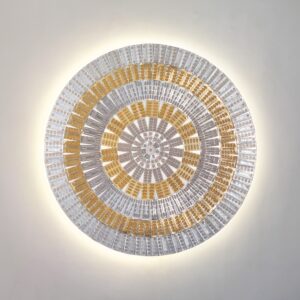
The non-negotiable value of medicine
However, Peggy Kliafa does not express simplistic generalizations or biased views. On the contrary, she painstakingly zooms in on the human condition, approaching contemporary existence with a philosophical, social, and aesthetic perspective.
“I do not cancel the non-negotiable importance of medical science and medicine. Medicines work miracles. Thanks to them, many people live, get out of bed every day and are functional, but they need moderation.
I wonder if some of the health issues that are linked to our lifestyle and choices wouldn’t even exist if we changed, or if they do exist, we can deal with them differently.
On a personal level, I believe that healing does not come only through medicines and medical treatment, but in many cases requires personal and internal repositioning and a change in the way of thinking and living.
On a social and humanistic level, my works raise questions about how we organize our daily lives, how we experience the city, and what is our relationship with the body and the community. It is a spiritual, holistic effort to reconnect body, soul, environment and society through symbols and forms that transcend the everyday and the utilitarian. I propose the re-design of our own existence, focusing on vulnerability, social responsibility, as well as the political and ethical dimension of health and life.
A breaking point
I also see Healing not only as a destination (a vaccine, a pill, a treatment), but also as a process – personal and collective – in which art, criticism, consciousness and care play a role. At the same time, the willingness to move away from our momentum can help, as well as reflection, pauses and small or large changes in ourselves and our habits.”
So, both aesthetically and symbolically, with the very struggle of spiritual, artistic creation, Peggy Kliafa proposes a third path. Instead of superficial solutions with a magic wand, she proposes a macroscopic view, a painful, slow process of “changing ourselves and our life choices.”
She clarifies, “I wanted the art in this context and the exhibition “Healing the Grid” to act as an intervention: A breaking point within the normality of the city and speed, a pause and revision, the search for the root of the problems.”
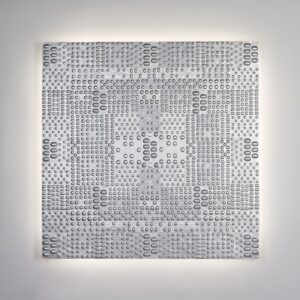
Artist, like entrepreneur
Peggy Kliafa entered the world of art through an initial venture in the world of business (after all, her husband is the important publisher Panagiotis Sakkoulas).
“The art world, especially for creators, requires long periods of introversion, introspection, and inner search. However, I’m not sure if it’s much different from the ‘business world’, and to move forward professionally, one also needs a lot of extroversion,” she explains bluntly.
And she further develops her thought:
“My previous professional experience in the business world helps me a lot as a professional visual artist and perhaps less so in creating works.”
Perhaps it is not so well known or expected, but visual artists, from the moment they are professionally active, are obliged to deal with various practical issues on a daily basis.
In communications, marketing, logistics, as well as in various organizational details, this knowledge and experience is very important.
My involvement with furniture has also helped me because of my familiarity with a variety of materials, while my involvement with publications has helped me in the creation of my catalogs and the organization of exhibitions.
I believe that in addition to my studies at the School of Fine Arts, my knowledge of mathematics and geometry, general knowledge and reading, visits to art exhibitions, everyday life, current affairs and of course personal experiences and emotions help me create works of art.”
Medicine as a conceptual canvas
The trigger for delving into the topic of Healing was given when Peggy Kliafa was still studying at the Athens School of Fine Arts and accidentally noticed a pill advertisement in a magazine.
“I started drawing it and wondering if it’s necessary to advertise medicines or if it’s obvious that if someone needs them, they’ll seek them out.”
Then the experience itself would turn its attention to the same topic: “should I take another pill for the headache?”, “should I give my children antibiotics again?”
“The concept of medicine functions as an “umbrella” for my overall artistic creation – a fundamental theme on which I develop my work – but often it simply becomes the vehicle for addressing other issues related to human existence.”
Since then, Peggy Kliafa has participated in numerous group exhibitions and presented three solo exhibitions.
Her works are included in notable private and public collections in Greece and abroad. This conversation finds her at a crucial stage, where her work shifts from personal to collective reflection, with philosophical and social questions beyond the individual body.

The Ziggurat as a search field
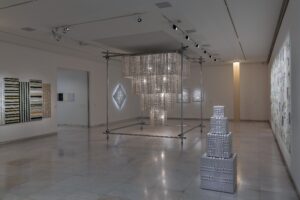
At the center of the exhibition space at the Zoumboulakis Galleries was a large chandelier in the form of an inverted ziggurat. This large composition was made up of transparent pill-capsules and empty pills blisters and was hung on a scaffold (three by three meters). The ziggurat, as the archetype of ascent and connection of heaven and earth, carries within it the concept of hierarchy.
As the curator of the exhibition, Sozita Goudouna, noted, “the exhibition does not simply present an aesthetic contrast between two forms (the rigid grid and the ascending ziggurat), but stages a philosophical and historical confrontation.”
As the well-known curator added, “the ziggurat, a sacred structure from Mesopotamia, represents a different way of understanding space, health, and society – a holistic, layered, and spiritually engaging one.
Meanwhile, the modernist grid, with its cold efficiency, reflects our contemporary condition: a world where systemic health crises—pollution, urban alienation, mental health epidemics—are met not with structural change but with pills, quick fixes that mask rather than mend”.
Peggy Kliafa added that “I was interested in its vertical dimension, in contrast to the horizontal coldness of the modernist grid. The ziggurat activates a physical and spiritual journey – a field of search, offering and healing”.
Aristotle, again
The discussion inevitably led to issues of identification and Aristotelian catharsis. On the one hand, for the creators themselves, how art leads to healing as a spiritual process and engagement with matter, and then how the reflection of this metaphysical and practical experience is transmitted to the viewer.
“The viewer’s relationship with large-scale works, and especially with those that incorporate light, acquires a sense of participation and confrontation.
The viewer is activated in ways that go beyond the traditional viewing experience. “You don’t just look at the work – you are in it.” The body becomes co-creator of the experience and affects space, light and materials, provoking a physical encounter with the work, beyond simple visual observation.
In this way, physical presence and interaction play a role in the transfer of meaning. The very structure of the works – large sculptures, luminous columns made of capsules, large wall collages – creates an environment where the viewer is not just an observer, but by experiencing the space, they also participate in the issues raised, wondering about the meaning of grid, order, control and therapy, especially in my latest solo exhibition. I would like the therapy to be physical, not abstract.
In large-scale installations, the viewer’s encounter with the work is often physical (participation in the space), sensory (use of light, large volumes, materials), and conceptual (reflection on the issues raised).
It is not just viewing, but dialogue and engagement, asking the viewer to experience, reflect on, and confront the issues and structures that the installations address.
All my works evoke a sense of redemption when they are finished and I feel like they have fulfilled their goal.”

Narrativeness
In this way, one could discern similarities between the creation of a work of art and the relationship with the Other.
“I hadn’t thought about it, but they do exist. In both cases, everything starts with an interest, curiosity, a spark, they require time to mature through phases of doubt and crisis, they require ‘a lot of work,’ honesty, commitment, and ultimately they transform us to some extent”, reflects Peggy Kliafa.
The works she presented at the Zoumboulakis Galleries, although abstract, one feels that they are imbued with human stories, with the traditional narrative in a certain way.
She liked the observation, and recalled her participation in the group exhibition “Material as Narrative” curated by Dr. Lina Tsikouta.
“The material of creation and its form can be charged in such a way that they create a narrative, refer to memories and stories,” she points out.
“Medicine and its packaging are typical examples of this. Pill capsules, effervescent tablets, pills blisters, syringes, vials, pharmacy bags… I use these materials both for their aesthetic value and because they are carriers of meanings and associations.”
The pills with their various colors and shapes, the capsules and pills blisters with their transparency and shine, or the aluminum blisters that are small sculptures in themselves, create a multitude of materials and ideas, which compose my works, just as another artist would work with paints, clay, mosaics, among other things.
On the other hand, they also carry a heavy load of meanings, often on the threshold between the therapeutic and the toxic. A pill can be a medicine or an addiction; a pharmacy bag can bring relief or act as a reminder of a long-standing illness.
It is natural that they also contain narration and make the work narrative as well,” she concludes.
