TA NEA
When pills become…works of art
Using empty bags and capsules, the artist Peggy Kliafa comments on life in Western metropolises
By Mary Adamopoulou
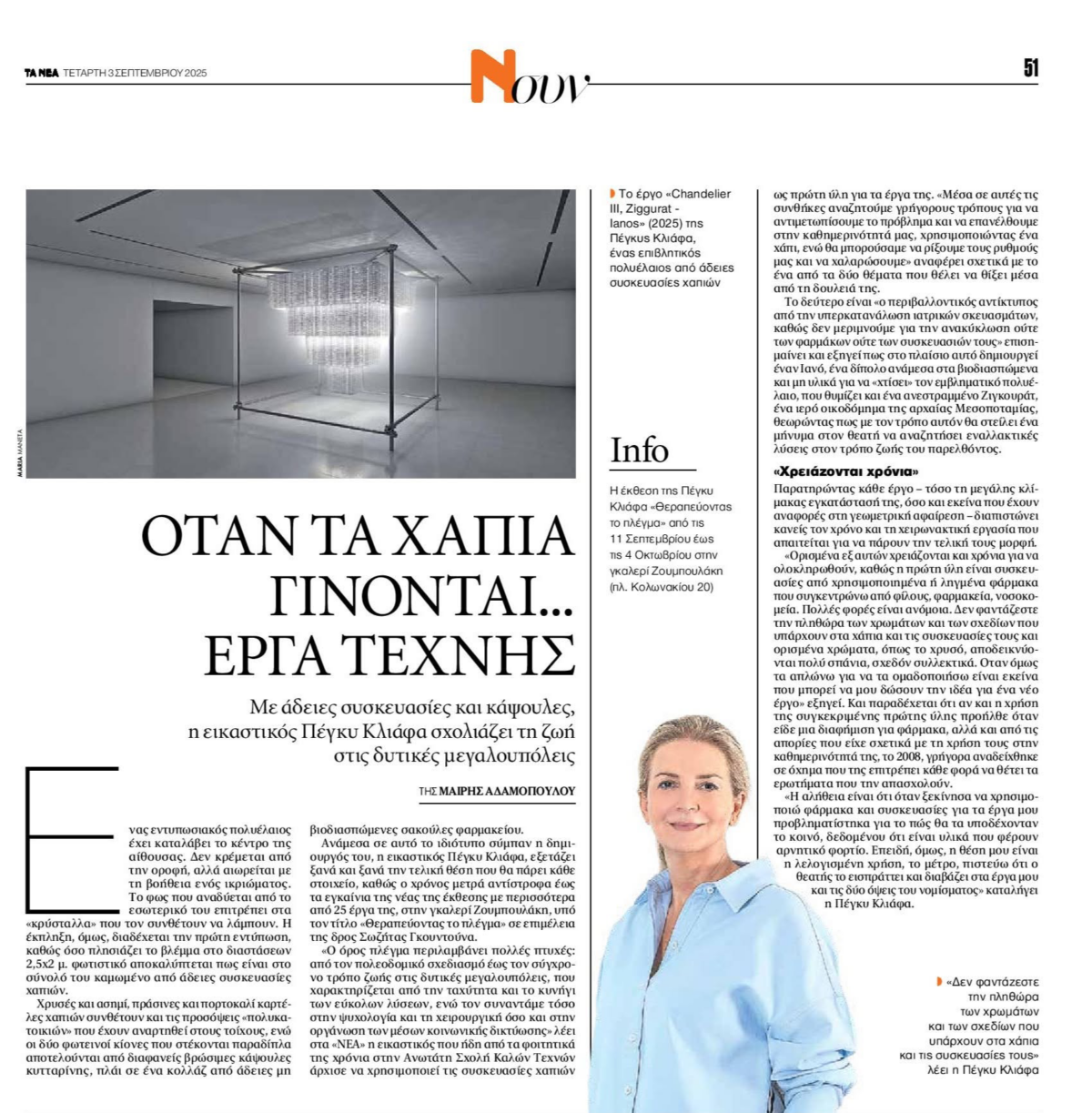
An impressive chandelier occupies the center of the room. It does not hang from the ceiling, but is suspended with the help of a scaffold. The light emerging from its interior allows the “crystals” that compose it to shine. Surprisingly, the closer you look at the 2.5×2 m. light fixture, it is revealed that it is entirely made of empty blisters.
Gold and silver, green and orange pills blisters compose the facades of “apartment buildings” that have been hung on the walls, while the two luminous columns standing close by are made of transparent edible cellulose capsules, next to a collage of empty non-biodegradable pharmacy bags.
Amidst this peculiar universe, its creator, the visual artist Peggy Kliafa, examines again and again the final position that each element will take, as the opening of her new exhibition with more than 25 works is approaching, at the Zoumboulakis Galleries, under the title “Healing the Grid” curated by Dr. Sozita Goudouna.
“The term grid comprises many aspects: from urban planning to the modern way of life in Western megacities, characterized by speed and the pursuit of easy solutions. We also encounter it in psychology and surgery as well as in the structure of social media”, explains the artist who, since her academic years at the Athens School of Fine Arts, began using pharmaceutical packaging as primary material for her works. “In these circumstances, we are looking for quick ways to deal with the problem in order to return to our daily lives, by using a pill, while we could slow down and relax”, she refers to one of the two issues she addresses through her work.
The other one is “the environmental impact of the overconsumption of medical supplies, as we do not recycle either the medicines or their packaging”, she points out. In this context she creates “Ianos”, a dipole composed of biodegradable and non-biodegradable materials forming an emblematic chandelier, which is also reminiscent of an inverted ziggurat, a sacred construction of ancient Mesopotamia. She believes that this artwork will encourage the viewer to seek alternative solutions to the lifestyle of the past.
“It takes years”
Observing each work – both her large-scale installation and those having references to geometric abstraction – one notices the time and manual labor required to take their final form.
“Some of them take years to complete, as the primary material is packages of used or expired medicines that I collect from friends, pharmacies and hospitals. They are often dissimilar. You can’t imagine the multitude of colors and designs of the pills and their packaging. Some colors, like gold, turn out to be very rare, almost collectible. But when I spread them out to group them, they are the ones that might give me the idea for a new project”, she points out. The artist also admits that although the use of this particular primary material derived from an advertisement for medicines, but also from the questions she had about their use in her everyday life, in 2008, it quickly emerged as a vehicle that allows her to express her concerns.
“The truth is that when I started using medicines and their packaging for my works, I worried about how the public would receive them, given that they are materials charged with negative energy. However, because my position is one of rational use, of moderation, I believe that the viewer appreciates it and sees both sides of the coin in my works,” concludes Peggy Kliafa.