ARTVIEWS.GR
Peggy Kliafa: The ziggurat as archetype of ascent and bridge between heaven and earth, carries within it a sense of hierarchy
Interview to Zeta Gioti
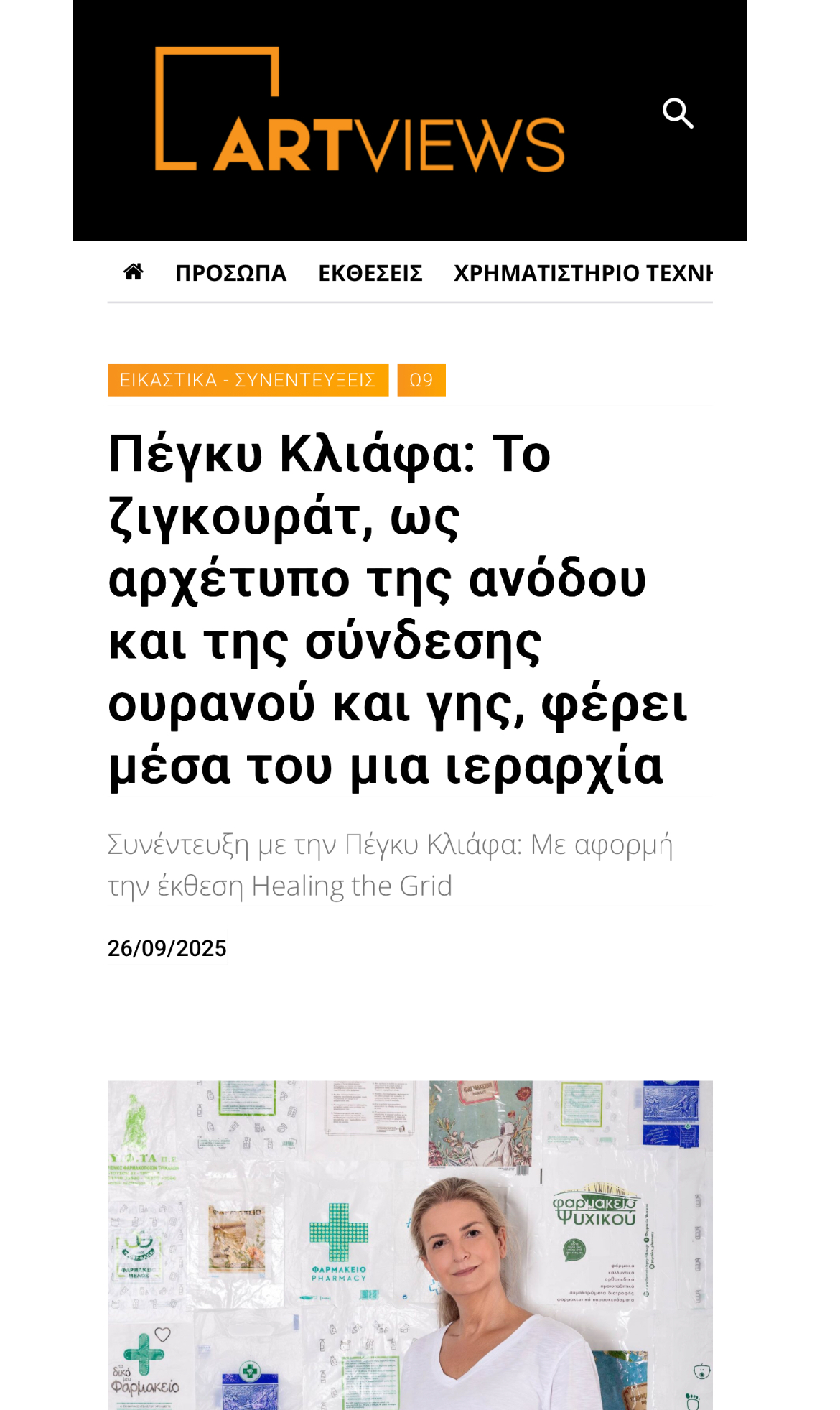
Peggy Kliafa’s new solo exhibition titled “Healing the Grid”, presented at Zoumboulakis Galleries in September 2025, brings into dialogue art with medicine, modernism with archaic wisdom and the geometry of the city with the metabolic architecture of the body. On the occasion of the exhibition, we discuss with the artist about the ideas, the pursuits and the symbolism that inspire her work.
We met the artist at the gallery, admired the works and talked with her.

-Peggy, the concept of “grid” occupies a central place in your work. How did the idea of connecting it to medicine and the broader view of health in modern society emerge?
-My work has always been connected to the “grid” morphologically and conceptually. It’s a form that is consistent with my temperament and is often imposed because of my primary material (pills blisters), which I compose into various works of geometric abstraction.
Furthermore, my work for many years has been connected to health, medicine and pharmaceutical issues. Their combination resulted from my observation that medicines and their overconsumption is a consequence of the stressful life in the city and especially in the metropolis, which is “synonymous” with the “grid”. It’s not only related to the city, but also to the Western lifestyle in general and the hyperconnectivity that characterizes another group of networks and grids in our lives.
Then I realized that the term is also widely used in the fields of medicine and psychology, meaning the network of nerves or vessels, surgical meshes etc.
What mainly concerns me, however, is how we react to the obvious or implicit pressure exerted by the various networks that have infiltrated our daily lives. How do we deal with the physical and mental health issues that arise from this lifestyle? Why do we often resort to medication, avoiding searching for the root of the problems and the painful changes in ourselves and our habits?
On the one hand, the grid as a structural and symbolic unit represents the order, the control, the rationality of modern urban life – it is almost a form of compulsion. On the other hand, we encounter different kinds of grids in medicine: neural networks, circulatory or lymphatic systems – structures that suggest life, flow, change. The idea of healing the grid was born from this duality.

-The theoretical framework of the exhibition refers to the ziggurat as the counterpoint to the modern grid. What led you to choose this ancient architectural form as a point of reference?
– The central work of the exhibition is indeed a large chandelier in the form of an inverted ziggurat suspended on a scaffold. From the very beginning, my work had references to architectural elements (stained glass windows, mosaics, etc.) and their connection to religion and healing in its early metaphysical phase, but also later on.
Thus this time as well, I was inspired by archetypal architectural elements such as the ziggurat, the columns, the squares, but also by contemporary large buildings/skyscrapers. I “dressed” them all in pills and their packaging in order to symbolically address health issues and the way to overcome them through Art History and Architecture.
Modern, consumerist society increasingly relies on medicines to maintain mental and physical health. However, even the most robust structures can be fragile and dependent.
The ziggurat, as archetype of ascent and bridge between heaven and earth, carries within it a sense of hierarchy. Contrary to the horizontal coldness of the modernist grid, the ziggurat caught my attention because of its vertical dimension. The ziggurat activates a physical and spiritual journey – an axis of pursuit, offering and healing. I wanted to suggest an alternative geometrical experience and reflect on how people nowadays choose to deal with the consequences of their stressful lifestyle.
-Your work seems to incorporate elements from art history, science and philosophy. How is your visual language shaped through these interdisciplinary pursuits?
-Contemporary art is a dialogue with the viewer but also with the history of art and philosophy. The particularity of my own visual language is that it also includes a dialogue with the history of science, namely medicine and pharmaceuticals.
I am not interested in the superficial aestheticization of science or philosophy, but in the deeper dialogue with them.
My work falls within contemporary art and has affinities with conceptual art, Arte Povera, minimalism and geometric abstraction, as well as with social and political art.
I am also interested in looking at older well-known works of art with new eyes. There are 2 works – homages to artists such as Joseph Albers and Sean Scully in this exhibition. I combine these elements adding an interdisciplinary and critical perspective to them. As a result, I create a personal and distinctive style that is not limited to a single movement.
My visual language takes the form of a multi-layered narrative, where science offers the materials and structural models (medicines, pharmaceutical packaging), philosophy poses questions (existence, truth, knowledge) and art history provides the aesthetic context and means of interpretation.
Through this interdisciplinary grid, I hope that my work is relevant, insightful, and open to multiple readings and reflections.

-The exhibition casts a critical eye over the drug-dependent approach to health. Do you believe that art can also work as a therapeutic mechanism?
-Yes, not in the sense of replacing medicine, but as a complementary path to understanding and relief. Art can promote empathy, reflection, self-knowledge. It can work as a mirror and at the same time as a bridge. In a world that treats the human body as a machine, art can reconnect it with the spirit.
Art, especially visual art, as a creative process, can “heal” either the artist or anyone who wants to use it as a means of self-expression. Manual labor and its visual aesthetic effect, as well as dedication and “emptying” the mind of worries, a sort of meditation, often help.
Furthermore, artistic creation can lighten emotions through non-verbal means of expression and become a source of satisfaction when original thinking gives birth to a new work of art from scratch.
Art therapy is increasingly being practiced internationally, and in many countries, both creative activities with specialist teachers-therapists and visits to museums and art spaces are now prescribed.
Which brings us to the other aspect of therapy through art, the one experienced by the viewer of the artworks. It is certainly a very subjective experience. For those who can truly stop time and immerse themselves in a work of art, it is a powerful and therapeutic experience.
For the viewer, healing often comes through emotional or physical engagement with the work. When a work triggers a sense of recognition, identification, or even unease, then it opens up space for reflection, perhaps even catharsis. Not healing in medical terms, but a deeper, experiential shift. I hope this exhibition and the light of the artworks embracing the viewers will create such feelings.
For me, art is not just an expression, but a tool for processing, understanding and transformation. As a visual artist, I can delve deeper into questions that concern me – existential, social, political. This process is therapeutic because it gives form to the formless, lights up dark areas and allows me to release tension and heal.
-The viewer is invited to experience the installation not only as an aesthetic experience but also as a physical one. How do you perceive the interaction between body and work in your exhibition design?
The body is not just a spectator, it is the co-creator of the experience. The installation was designed to provoke movements, pauses, breaths – as a temple or a therapeutic environment would.
I would like the visitor to feel that they are passing through a “grid” that personally concerns them. To be activated not only mentally, but also physically, to feel the weight and rhythm of the space.
My goal is for the viewer to participate. Not to forget the city or the other grids that surround them, but to see them differently – to notice how they themselves are inscribed within the grid. I would like the therapy also to be physical, not abstract: to go through sensation, observation, participation.
Large-scale works of art that use light have a special power to activate the viewer in ways that go beyond the traditional viewing experience. You don’t just look at the artwork—you are in it. Light fills the space, touches the body, affects vision and often creates conditions that require physical movement and adaptation.
It can affect mood (relaxation, tension, awe) and activate attention and perception mechanisms – it makes the viewer actively observe. I hope it is a “therapeutic” experience as well.

– The use of the grid in this exhibition seems to hint at the imposition of social or political structures. Do you also intend to comment on issues of power or control through your work?
-The grid, as a tool for urban and data planning, as a synonym for digital surveillance infrastructure, as well as for social or other networks, is clearly linked to mechanisms of power and control.
Art cannot remain uninvolved. I don’t believe it should provide solutions, but rather raise concerns. Without being directly political, the artwork comments on the biopolitics of the modern world: how the body, information and health are controlled.
The healing of the grid is also a proposal for “resistance”, introspection and perhaps reinterpretation, in the face of the invisible compulsion that we experience daily.
All kinds of “grids”, architectural, medical, social, digital, spiritual, that surround us daily, can easily become “oppressive structures” as well as “systems of power and control”, either with or without our consent. Our pharmaceutical addiction takes the form of another rigid, cold, executive grid that does not aim to cure diseases, but to provide superficial quick fixes. It is, therefore, an oppressive, completely controlled system that gives the impression of bringing order to chaos, while in reality it stultifies.
-What was the role of the curator, Dr. Sozita Goudouna, in shaping the exhibition and how did your creative collaboration evolve?
Sozita is a curator-writer with extensive experience, deep knowledge of Art Theory and History, as well as of the international contemporary art scene.
The fact that we had collaborated repeatedly in the past on various projects and that she knows my work in depth helped us overcome the difficulties created by distance, because she is living and working in New York lately. In addition, the theme of this exhibition is closely related to life in the big city, so her daily experiences there inspired her.
Our discussions were immensely helpful both in organizing the works and in writing the wonderful catalogue text. Her broad-mindedness, as well as her insightful approach to art enriched the theoretical background of the exhibition.
Our collaboration was a profound dialogue– a coexistence, not a mere curation. Through discussion and exchange of ideas, the exhibition took a clearer form and connected with buried concepts that have finally emerged.
– To what extent is this exhibition a continuation of your previous research and artistic pursuit? Do you see your work evolving?
Yes, absolutely. It is a continuation simultaneously at the level of concept, reflections, form and materials. Most of the works of the exhibition have been created within the last two years.
I could not prepare an exhibition in a shorter period of time, because all the works are very time-consuming to construct and require the collection and classification of rare materials. Because of this continuity, there are also earlier works in the exhibition and in the catalogue that focus on the same theme or use the same materials.
The stressful life in cities and the Western hyperconnected world, the quest for meaning through material and immaterial grids, the pharmaceutical therapies while avoiding radical changes to ourselves and our daily lives, are issues that have concerned me for years.
“Therapy” does not limit itself to mere issues, it is also personal. I try to get closer to the essence of things through my works. I would say that this exhibition is a turning point – not a break from the past, but a conceptual immersion and morphological expansion.
-The reference to the “living” and “breathing” nature of the grid raises questions about the materiality and metaphysical dimension of the installation. How will you activate this dimension?
The concept of the “living and breathing nature of the grid” in the exhibition “Healing the Grid” functions as a crucial shift from form to the metaphysical dimension of the installation and touches on existential, physical and philosophical issues.
Behind the superficial “geometry”, the grid is activated as a symbol that touches the material and the immaterial, the measurable and the irrational, the trauma and the healing.
The central installation and the two light columns are made of materials that are light-permeable and sometimes react to the movement of the body. My goal was to give the impression that the grid is pulsating, that it is not static, that it “breathes”.
To activate this metaphysical dimension, I worked very consciously with materiality: transparent or translucent materials often with traces of use, organic textures, special lighting. The work is not complete without the presence of the viewer. On the contrary, it is activated by it. I would like the viewer to feel that the grid is “reading” them, that they are participating in a ritual of reconnection.
The metaphysical dimension is not necessarily otherworldly. It is a reminder that beneath the surface there is an energy, an intention, a unity, an interiority that transcends the visible. A condition of calmness and reflection is created, an energetic space, a network that brings form, experience and meaning together.
Now that the exhibition is set up, I notice visitors standing in front of the works for a long time, isolated as if praying. I tried to create a condition of presence: not only to see the grid, but to listen to it. To feel that, like the body, the structures that surround us can fall ill, but also be healed.
-What are your next steps on the artistic map? Do you plan to continue exploring the relationship between art, science and society?
Ιn parallel with my solo exhibition, I am participating in a group exhibition entitled “Elements of Harmony” in New York, also curated by Dr. Sozita Goudouna, under the auspices of the Greece in USA organization and produced by Maria Kosmidou.
In October I will participate in a group exhibition of artists’ books entitled “BOOKMORPHS: Artists’ Books from Greece & the United Kingdom” at the Hellenic Centre in London, with the participation of Greek and British artists. The exhibition is curated by Project 2 Athens (Fiona Mouzakiti & Despina Stavrou) and Christina Mitrentse, while the introduction of the exhibition catalogue has been written by the Director of the Greek Centre, Dr. Nayia Yiakoumaki.
I am planning a solo exhibition at the Lola Nikolaou Gallery in Thessaloniki in 2026. Other projects/exhibitions are still in the planning stage.
After the “Healing the Grid” exhibition, it is very likely that I will continue to explore and work on subject areas related to art, science and society, and in particular to medicines, the biopolitics of body, urbanity and healing.
These are timeless and always relevant issues, because something new constantly comes up: from simple everyday issues to groundbreaking and unexpected ones, like the recent pandemic. These are universal and existential concerns.