CultureNow.gr
Peggy Kliafa: Creation is a therapeutic process
Zoumboulakis Galleries present Peggy Kliafa’s new solo exhibition titled “Healing the Grid”.
Interview by Stratis Pantazis
“The grid is the silent dictator of modernity. It structures our cities, our screens, and even our medicine cabinets. From the relentless right angles of Manhattan’s skyline to the clinical precision of pharmaceutical packaging, the grid imposes an illusion of order upon the chaos of life. Yet, beneath its rational veneer lies a paradox—it both sustains and suffocates, heals, and controls” – Dr. Sozita Goudouna, excerpt from the exhibition catalogue.
What is the grid for you?
The “grid” is a polysemic symbol that works simultaneously on a morphological and conceptual/metaphorical level. Firstly, it is a tool for visual artists and I have personally been using it in my work for years. In this particular exhibition, however, I also refer to its other various versions. It is metaphorically synonymous with the city, due to its urban planning. The grid also includes cable networks and, by extension, all modern networks, such as the internet, social networks, and hyperconnectivity, which affects our society. In a way, the word grid represents for me many aspects of the Western lifestyle in big cities. The expression “off-the-grid” means a somewhat utopian “disconnection from modern civilization” and the internet and a life closer to nature, less harmful for the environment.
At the same time, the grid is also associated with the human body in the medical sense. The grid as a structural and symbolic unit, on the one hand, represents the order, control, rationality of modern urban life – it is almost a form of compulsion. On the other hand, in medicine we encounter different kinds of grids: neural networks, circulatory or lymphatic systems – structures that suggest life, flow, change. The idea of healing the grid was born from this duality.
How does the work consisting of pharmacy bags connect to the concept of grid?
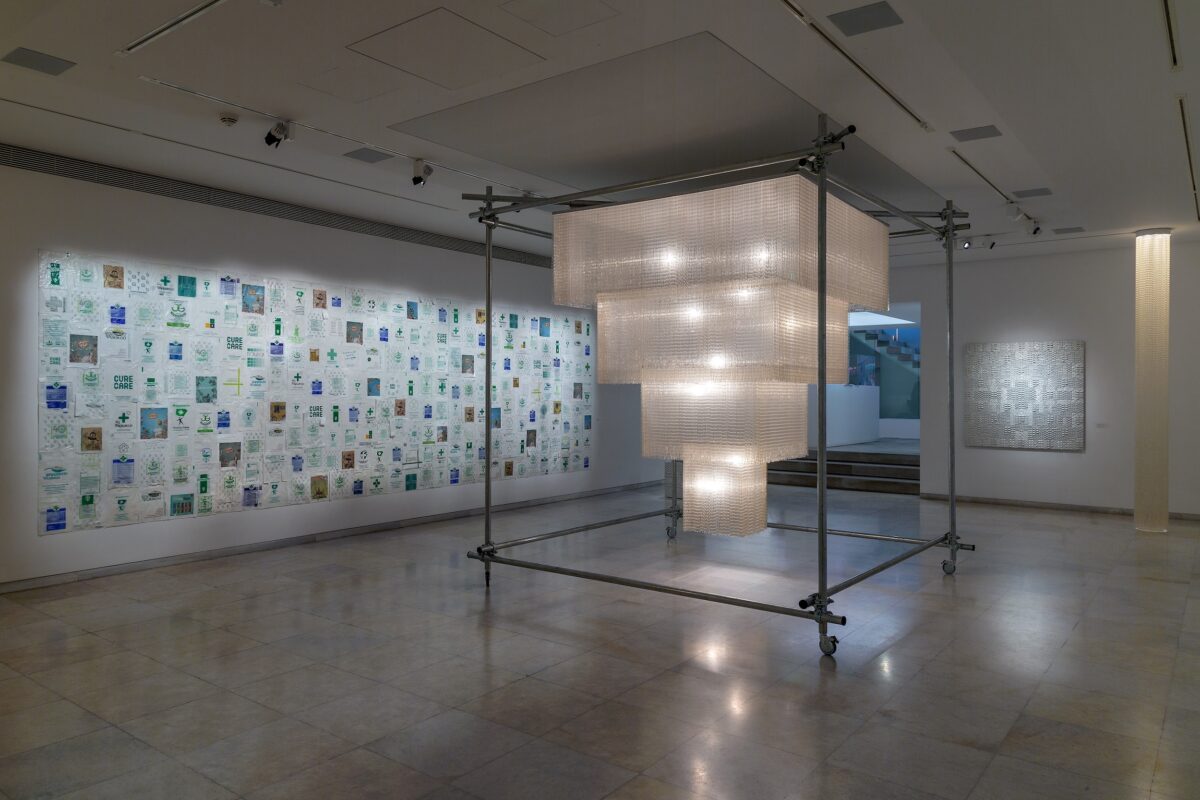
This is the work titled “SIDE EFFECTS or BAGS OF HOPE”, a large seven-meter collage of non-biodegradable plastic pharmacy bags, like wallpaper. The work morphologically is a somewhat “free” grid with a multitude of colors, shapes, letters and logos structured in ordered patterns. It is a contemporary palimpsest, with layers, with everyday images of the city. In the dynamics of the exhibition, it is a work that balances the strict geometry of the other works.
Unchangeable: the use of pharmaceutical bags (symbols of healing) in contrast with their non-biodegradable nature creates an ironic tension: a grid that is supposed to heal, ultimately harms. The title of the exhibition suggests an attempt to heal this problematic grid. By recomposing its elements (plastic bags) into a work of art, I attempt to transform a traumatic or toxic material into something with new meaning.
The grid as a system refers to structures of power, control, consumption and habits. Pharmacy bags are part of such a grid: they bring to light everyday life, dependence on the pharmacy, the health system, but also the overconsumption of plastic. On the other hand, this work highlights the network of human relationships surrounding health. They are often relationships charged with anxiety, despair, and hope. Used pharmacy bags symbolize the landmark of finding a solution to the problem, the pharmacist himself, who in societies like ours constitutes “our man” and the connecting link of the neighborhood.
In the central installation, you are inspired by the ziggurat and its symbolism. But why is it upside down and reminiscent of a chandelier?
The central work of the exhibition is indeed a large chandelier in the form of an inverted Ziggurat, suspended from a scaffold. From the very beginning, my work has architectural references (stained glass, mosaics, etc.). I am also interested in their connection to religion and healing in its early metaphysical phase, but also later. I was inspired once more by archetypal architectural elements such as the Ziggurat, the columns, the squares, but also by modern large buildings/skyscrapers. I “covered” them all with pills and their packaging, in order to symbolically address health problems and their solutions through the history of Art and Architecture. Modern society, a clearly consumer culture, increasingly relies on medicines to maintain the “stability” of mental and physical health. But even the most robust structures can be fragile and addicted.
The ziggurat, as an archetype of ascent and the connection between heaven and earth, carries a hierarchy within it. I was interested in its vertical dimension, in contrast to the horizontal coldness of the modernist grid. The ziggurat activates a physical and spiritual journey – an axis of search, offering and healing. I wanted to suggest to the viewer an alternative geometry of experience and a reflection on how they choose to heal the consequences of the modern, stressful lifestyle.
The inverted Ziggurat-Chandelier was both a morphological and a substantial choice for me. In addition to the inversion, there is another peculiarity: two consecutive sides of the work are made of empty pills blisters, while the other two are made of hanging rows of transparent cellulose capsules. In any case, it is a subversion of the expected, a creation of contrasts. Two sides made of empty pills blisters (the containing) and two with their pills (the content), two fixed and immobile and two airy with the ability to move, biodegradable and non-biodegradable, strictly rectangular and free. It could be a subversion of symbols, power, luxury and spirituality, a social and environmental critique, an occasion to reflect on our relationship with the grid.
The installation is set in a metal frame, reminiscent of a cube. The shapes of cube and square are present in your other works, too. Is there any conceptual symbolism?
Indeed, the shapes of square and cube occupy a large part of my artistic creation. This is obviously a morphological and conceptual choice. The square shape of my wall art is driven both by an instinctive preference and the blister material I use. The symbolisms of square are numerous, as are the references to Art History and especially to Modernism. I will insist more on the symmetry, stability, rationality and purity that characterize the square. Accordingly, the cube created around the central work of the exhibition – the inverted Ziggurat – is a structure of pipes and connections, permeable, a scaffold. The choice of this “cube” was made for practical reasons, because the work is suspended in it, as well as morphological and conceptual ones. Scaffolding is an element associated with architecture, building construction, urbanity, noise, images and sounds of the city and the need for “healing” the urban grid. Furthermore, the cube in art history depicts the essence of objects through simplified forms. It is generally a symbol of human intervention in nature, a symbol of culture. Hence my question about whether, starting from the era of ancient Mesopotamia and the Ziggurats, where we encounter the first organized cities, the evolution of civilization continues to have a positive sign. I feel that somewhere in the 18th century this doubt was born in people’s minds that every step towards civilization might have a positive and a negative aspect. The two sides of things, like the work inscribed inside the cube, like the “medicine”, like the “grid”.
You use or imply light in the chandeliers, the stained glass windows and most of your works. What does it mean for you?
I first used light in my stained glass and chandeliers, where its use is somewhat self-evident and functional. However, the presence of medicine and its packaging lend conceptual dimensions to it. Light has the ability to transform some materials, especially those with transparency, gloss and reflectivity. The relief monochrome wall artworks of geometric abstraction have perimeter light, which I think gives them a mystical dimension. Light becomes a carrier of spirituality and tranquility, referring to Byzantine models.
Light and its contrast with darkness are used symbolically: as “medicine,” healing, relief, hope, or metaphorically in the sense that art itself, with its light, can “heal” — the artist, the viewer, the space. Light is defined as life, as eternal life — and that is what medicines are aiming for since the days of alchemy. I use light because I believe in the positive contribution of medicines, as long as there is prudence and moderation.
In this exhibition and especially in the central installation, my goal, by the use of light, amongst others, is for the viewer to participate. Not to forget the city or the diverse grids surrounding them, but to see them differently – to observe how they themselves are inscribed within the grid. I would like for the therapy to be physical, not abstract: to move from sensation and observation to participation. Large-scale works of art, which use light, have a special power to activate the viewer in ways that go beyond the traditional viewing experience. You don’t just look at the work—you are in it. Light fills the space, touches the body, affects vision, and often creates conditions that require physical movement and adaptation. It can affect mood (relaxation, tension, awe) and activate attention and perception mechanisms — it makes the viewer observe actively rather than passively. I hope it is a “therapeutic” experience as well. Now that the exhibition is set up, I notice that there are visitors who stand for hours in front of the works, isolated and focused, as if they are praying.
Do you agree with the role of the artist as shaman, advocated by Joseph Beuys? Can healing, transformation and rebirth come through art, amidst the complexity that characterizes our era?
Joseph Beuys was one of the most important and influential artists of the 20th century, not only because of his work, but also his vision for art and society. I share many of his views and understand his contribution to the times in which he lived and created. I greatly admire his passion. Personally, by temperament, I don’t believe in provocation through art. I prefer my art to hint and suggest in a gentle way.
A kind of healing is possible through art, but not in the sense of replacing medicine, but as a complementary way of understanding and relief. Art can offer a safe space for empathy, reflection, self-knowledge. It can work as a mirror – and at the same time as a bridge. In a world that treats the body as a machine, art can reconnect it with its spirit.
Art, and especially visual art, as a form of creation, is capable of “healing” either the artist or anyone who wants to express themselves through it. Manual labor and its visual aesthetic result, dedication to this purpose, and “emptying” the mind of worries, something like meditation, often help. Also, visual creation can achieve the release of emotions through non-verbal means of expression and give great satisfaction when original thinking gives birth to a new work of art from scratch. Art therapy is increasingly being practiced internationally, and in many countries, both creative work with teachers-therapists and visits to museums and art spaces are now prescribed.
Which brings us to the other kind of therapy through art, the one experienced by the viewer of the works. It certainly is a very subjective experience. For those who can actually enjoy a work of art, stop time and immerse themselves in it, I believe it is a powerful and healing experience. For the viewer, healing often comes through emotional or physical engagement with the work. When a work triggers a sense of recognition, identification, or even unease, then it opens up space for reflection, perhaps even catharsis. We are not talking about healing in medical terms, but about a deeper, experiential shift. I hope this exhibition and the light of the works that embraces the viewer will stir up such feelings.
For me, art is not just an expression, but a tool for processing, understanding and transformation. As a visual artist, through creation I can delve deeper into questions that concern me – existential, social, political. This process is therapeutic because it gives form to the formless, brings light to dark areas, and allows me to release and restore.